Showing posts with label Brain health. Show all posts

Gluten: What You Need to Know

It seems like everywhere you look there's a new gluten free item on the supermarket shelf, a restaurant with a gluten free menu, or a friend "going gluten free". But what's all the fuss over this one little molecule? And why is it becoming increasingly popular to avoid it?
Gluten is the protein found in wheat, barley and rye, and it is what gives many foods their form and texture. Think of it as the "glue" that holds bread products together. Gluten enteropathy, or Celiac Disease (CD), is an autoimmune disease in which the individual reacts to gluten and produce an autoimmune-mediated attack on their intestines. Currently it is estimated that CD affects 1 in every 133 people in the US, with a predilection for Caucasian people and women. More shockingly, it is estimated that 80% of people with Celiac Disease are unaware they have the disease [1]. Diagnosis of CD requires either a positive Anti-gliadin antibody test or Tissue Transglutaminase test, as well as a biopsy of the small intestines showing gross damage to the villi of the intestines. Often times a third test is used, a genetic test that looks for the "Celiac genotype" of either HLA-DQ2 or HLA-DQ8.

Okay, so it makes sense that if you have CD you shouldn't eat gluten. But then there's the real weirdos out there: the 1.6 million Americans who are on a gluten free diet but are not diagnosed with Celiac Disease. Why in the world would people without Celiac Disease go gluten-free?

Because you don't have to be Celiac to have an immunological, and very real reaction to gluten. As a matter of fact, scientists now believe that occult cases of CD account for an astonishingly low number of gluten sensitive individuals. As a matter of fact, research is now showing that those people with enteropathy (disease of the intestinal tract) represents only 1/3 of the patients with neurological manifestations of gluten sensitivity [3]! The vast majority of autoimmune patients are highly sensitive to gluten (and casein) and feel much better when they remove it from their diets. Remember, just because the intestinal tract itself isn't being attacked doesn't mean that the immune system isn't attacking another tissue. In CD it's the gut that gets chewed up, in RA it's the joints, in Hashimoto's it's the thyroid. In any case the immune system reacts to the foreign protein and stimulates an immune attack- it's just a matter of where they send the troops.
The problem is that most doctors have yet to acknowledge that non-celiacs can have a problem with gluten. To them, the "Celiac test" IS "the gluten test", but that is absolutely not true. I have heard countless stories from patients with the same experience: "my doctor said it was all in my head... They said I had no problem with gluten." It's so sad, because these people knew that their bodies did not tolerate gluten, but at the insistence of their ignorant doctors they continued to eat the foods that were contributing to their misery.

Here's what you need to know about gluten sensitivity testing and where you can go to get answers.

There are three main problems with traditional Celiac testing that cause gluten-sensitive folks to fall through the cracks.

1. The majority of testing uses the antibody IgA. However secretory IgA is commonly depleted in autoimmune patients, who make up a large percentage of gluten sensitive people. This means that the IgA test can come back low enough to fall into the "negative" range, when in actuality the patients' body was just not making any IgA, let alone IgA against gluten. To combat the risk of false negatives, look for tests that include either IgG or IgM in addition to IgA.

2. Celiac genotype testing is boarder-line useless, but many physicians will not consider you to have CD unless you have the HLA genotype. While 90+% of CD patients are HLA-DQ2 positive, approximately 30% of those of Caucasian decent have this genotype, too! This means that the genotype testing has pretty good sensitivity, but really lousy specificity. That and again, this test is looking for people with occult Celiac Disease, so those who are non-celiac gluten-sensitive would be passed by yet again.

3. The main problem with celiac and gluten testing is that the test only looks for sensitivity against one of the many components of wheat. The anti-gliadin antibody testing used do diagnose CD only tests for Alpha Gliadin- one of 12 or so components of wheat and gluten! Not only that, but most current testing does not test for reactions to wheat versus rye or barley- they assume that the structure is similar enough that they would all produce a positive test result to Alpha-Gliadin.
So what should you do if you believe you are one of the many who have an issue with gluten? The best advise I can give you is to listen to your body!

The cheapest way to find out if you have a food sensitivity is to do a good ol' fashioned food elimination test. That is, cut it out of your diet for a few months, then add it back in and see what happens. We need to re-learn as a species how to listen to our bodies. Back when we were in the bush we would simply know to avoid a food if it made us feel bad. Nobody needed blood tests and peer-reviewed, double blind, placebo controlled trials- it was common sense that your body knew what's best.

I recommend doing an elimination diet with the most common allergens: gluten, dairy, soy, eggs, and peanuts. Give your gut and your immune system a break from these inflammatory foods for a few months with absolutely no cheating. If you can do things to heal your gut (coming in a later post) during that time then all the better. After a few months have passed, slowly start re-introducing foods into your diet, about once every 3-4 days. Recall, it takes the epithelial cells in your gut approximately 3-5 days to regenerate, so it will take you that long to rebound from each new food. As you reintroduce foods, keep an eye out for any symptom: from restless leg syndrome, to gut problems, to pain or insomnia. Remember, the immune system lives in the entire body, so symptoms can pop up anywhere. If you have an autoimmune disease, specifically keep your eyes peeled for symptoms of your disease (ex. joint pain in RA, hypo or hyperthyroidism symptoms in hashimoto's or graves disease, etc). Of course, the entire point of the diet is to avoid the foods that produced any adverse reactions, so listen to your body and stay away from the stuff after that!

For those of you who like to see results that clearly tell you "you can eat this, you can't eat that", you are in luck. A few years ago a lab based out of Phoenix, AZ started running an amazing panel for gluten sensitivity and it is being implemented in functional medicine practices throughout the country. For more information about the lab visit http://www.cyrexlabs.com/. It has been my personal experience with this lab that they are very helpful, and if you ask them they will find you a doctor in your area who runs their tests.

Always in health,

Nikki


References:
[1] http://www.mayoclinic.org/news2012-rst/7008.html
[2] Chart recreated from Datis Kharrazian's seminar notes "Understanding the complexity of gluten sensitivity" 2011
[3] J neurol Neurosurg Psychiatry, 2007:72;560-563. Gluten sensitivity as a neurological illness.

Recommended videos:
[Tom O'Bryan] http://www.youtube.com/watch?v=DjvKrAvolMQ

Recommended websites:
http://www.theglutensyndrome.net/
http://www.glutenfreesociety.org/gluten-free-society-blog/grain-a-double-edged-sword/
[THE lab]  http://www.cyrexlabs.com/
[Great GFDF recipes!]  http://www.nourishingmeals.com/
[An example of how gluten attacks more than the gut]  http://www.livingwithout.com/issues/4_12/ataxia-2366-1.html


Leaky Gut Syndome Part 1: Understanding the Gut

They say you don't appreciate what you have until it's gone. Similarly, I think you don't truly appreciate good digestion until it's gone. For a shrinking part of the population digestion simply doesn't cross their minds, but with the increased incidence of Celiac disease, Crohn's disease and Ulcerative Colitis (both considered types of Inflammatory Bowel Disease, or IBD), gastroparesis, and Irritable Bowel Syndrome, digestions is on more people's minds than ever now.

So what do all these gut problems share in common? Even though each of these have their own set of diagnostic criteria and symptoms, what if they were all in fact part of a much longer problem?

Leaky gut syndrome, also known in the scientific literature as "impaired/increased intestinal permeability", is exactly what it sounds like. The gut barrier can become compromised for a number of reasons, and when it does it is less able to control what comes in and out of the gut. We will get into the gravity of this situation a little later, but first I want to explain normal gut function and how important it is.

Before you can understand abnormal you must understand normal. The gastrointestinal tract (GIT for short) is actually considered to be outside the body. Remember those weird water tube toys from the 90's? They were one continuous loop of plastic with one hole at either end and water inside.When you tried to hold onto it, it would turn in on itself making it nearly impossible to grasp (not unlike a slippery bar of soap). The human body is really no different: we are a tube within a tube. This makes the gut lining's job even more important- not only is each epithelial cell in charge of absorbing good nutrients from our food, but they have to be able to keep the unwanted crud out. This includes allergens, unfriendly critters, undigested food particles, chemicals, and potential toxins.
There are two ways that stuff can get into our bodies through the gut lining- by going between the cells or through a cell. These are called the paracellular pathway and the transcellular pathway. Each cell is held together by "tight junction proteins" called occludin and zonulin. When these proteins are destroyed or weakened the paracellular pathway becomes compromised, allowing passage into the underlying tissue. Transcellular passage happens when cells are destroyed (an example of this that you can actually see on biopsy is the villous atrophy seen in celiac disease) or when they fail to do their job properly.
The gut is home to approximately 70% of your immune cells- a brilliant tactic by the body if you ask me. With all the stuff our gastrointestinal system comes in contact with (food particles, chemicals, critters) it makes sense to put the guards of our bodies there to wait for the ambush. The analogy I like to use is if you were going to build a castle, where would you put your guards? Would you have them in a room inside the castle, or would you have them poised to defend you at the gate should the moat fail to stop your enemies?

Under normal conditions your gut has several lines of defense to protect itself. The first, and one that people often forget, is your digestive enzymes. Few bugs can actually survive the harsh, acidic environment of the stomach, so stomach acid serves as a great disinfectant right off the get-go. Not only that, but the digestion of food by our acids and enzymes breaks down the large molecules such as gluten and casein so they can be more easily metabolized by the enterocytes. Without proper digestion by these enzymes, large otherwise harmless macromolecules such as gluten are allowed to come in contact with new areas of the GIT as well as the immune system.

In the intestines (where the vast majority of our food is actually absorbed) there are several other defense mechanisms in place. The immunoglobulin IgA is abundant in the gut and aids in the binding and removal of antigens and bugs. Additionally, the microbes that make their homes in our guts play an immensely important role in our health. These microbes help modulate the immune system and relay information to the underlying dendritic cells and enterocytes. Some bacteria actually make things for us that we would otherwise not be able to make ourselves, like vitamin K. These critters are in constant communication with our cells as well as each other, and we are just starting to understand just how important they are.

Up next: What causes leaky gut syndrome?

Nikki


Resources:
A great TED video about bacteria:
http://www.ted.com/talks/bonnie_bassler_on_how_bacteria_communicate.html


Pictures taken from: 
Menard S, Multiple facets of intestinal permeability and epithelial handling of dietary antigens, 2010 May, Vol 3 Issue 3, P 247-259.

Functional Neurology

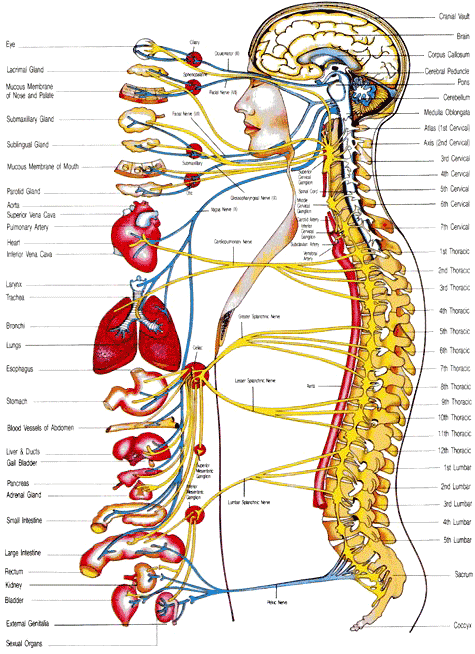
Chiropractors have been boasting for years that we are neurology specialists- that we treat the spine, and therefore the nervous system. One classic explanation for this is because an important part of the central nervous system, the spinal cord, lies within the spinal canal that goes through each vertebrae. Another commonly used explanation for this is that subluxation, that "bone out of place" that chiropractors adjust, can put pressure on the spinal nerves and obstructs nerve flow or vital force that goes to each target organ. And while both of those theories may be true to some extent, there seems to be a better explanation, however.
More recently (since about the 80s or 90s) as our understanding of neurology has advanced, so has our understanding of chiropractic's affect on the nervous system. Simply put, adjustments are felt by the patient, which means that they are somehow sensed and interpreted by the brain. Depending on the location of the adjustment, the type of adjustment, or the timing of the treatment, the brain will interpret that information a different way. This also calls attention to the very real, but all too forgotten reality that everything in our lives provides different stimulation to our brains. Whether it be the food we eat, the sensory information from our feet, or the thoughts we think, everything is perceived by the big guy upstairs- whether we are consciously aware of it or not. Furthermore, the brain has the remarkable ability to adapt to the stimulation it recieves- or as we in the biz call it, neuroplasticity. This is the basis for neurological stimulation such as what we use in functional neurology. As the weak circuitry is stimulated, the pathways are strengthened and allowed to operate more smoothly.
As a clinician who wants to help the more "complicated" patients out there, I find it will be especially important for me to know not only how the body affects the brain, but how the brain affects the rest of the body. This is why I have chosen to study chiropractic neurology (also called functional neurology). Functional neurologist take extensive classwork in addition to their chiropractic degree coursework to further understand the nervous system. To get a diplomate in functional neurology one must complete a minimum of 300 hours of additional coursework in neurology and pass a rigorous clinically oriented test. Many chiropractic neurologists are also well versed in functional medicine- another critically important skill set when treating the so called "complicated" patients that are becoming increasingly common now.

Chiropractic neurology has received a lot of press in the last few months, mostly because of Dr. Ted Carrick's work treating hockey star Syd Crosby. Since then, Carrick and functional neurology has seen a lot of positive press, as well as a lot of skepticism. For example, one particularly rude reader commented on an article about Crosby that "last he knew, concussion was not caused by a subluxation"... And I agree, but we never claimed that it was! When applied in a specific way that is unique to the patient's neurological needs, chiropractic adjustments can be a very powerful and effective way to stimulate the brain. Furthermore, functional neurologists such as Carrick use a variety of treatments in conjunction with their adjustments including eye exercises, as well as balance and coordination exercises. That poster's comment not only reveals a clear lack of understanding of basic neurology and neuroplasticity, but an unawareness of what chiropractic neurology is all about!

Chiropractic neurology helps the brain function at it's very best. Certainly anybody could benefit from chiropractic neurology, but it is particularly great for people with neurological disease or symptoms. If you know of someone who's brain is not functioning at it's best, finding a qualified chiropractor near you may make a world of difference in that person's life. I encourage you to go on the American Chiropractic Neurology board's website and find a chiropractic neurologist near you!

Passionately helping others,

Nikki


Resources!
Doctor locator-
http://acnb.org/doctor-locator

More on Crosby and Carrick-
http://video.ca.msn.com/watch/video/inside-hockey-sidney-crosby/16atihz31
http://prohockeytalk.nbcsports.com/2012/01/16/crosby-to-see-chiropractic-neurology-specialist/

More about Functional Neurology in the press-
http://vimeo.com/47787677 (recently on ABC's nightline)

Trailer and information about the functional neurology movie  Hope Restored-
http://www.myhoperestored.com/

A fun read on neuroplasticity and changing your thoughts for the better-
http://www.mysticmusingsandmeditations.com/2010/03/is-it-really-possible-to-rewire-your-brain-7-days-to-a-new-positive-you/